Archive

Archive for the ‘art 466 Demos’ Category

Combat Paper workshop at UW-Madison Paper Lab

October 3rd, 2009 admin No comments

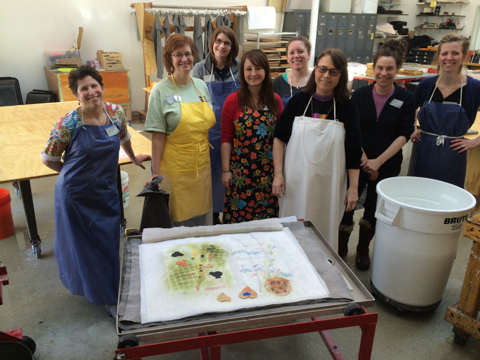
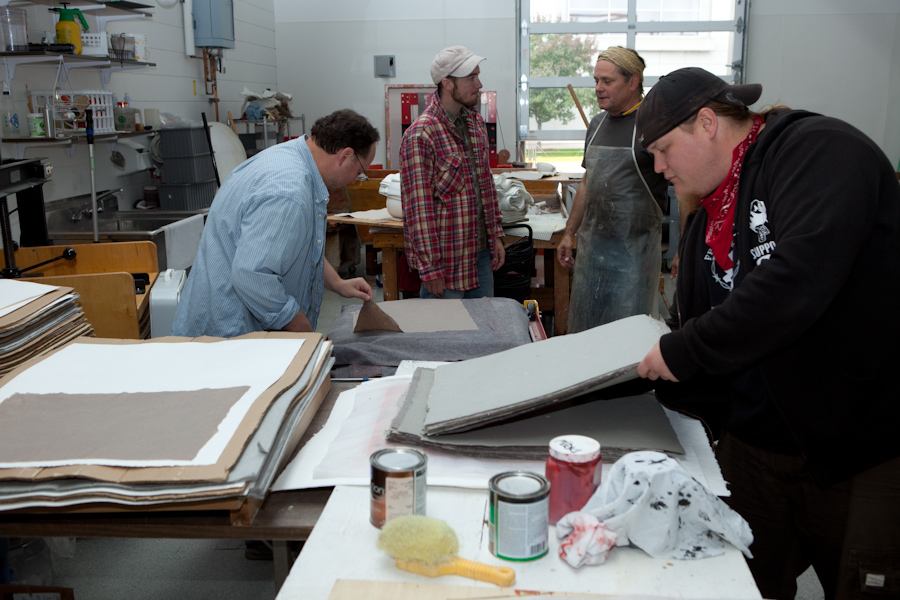
20091003_Combat-Paper-065October 1, 2 & 3 Drew Cameron, Robert Possehl and Drew Matott conducted a workshop for veterans as part of the Combat Paper project. You can learn more about the efforts at the Combat Paper Organization site. A link of photographs can be viewed from the Combat Paper workshop.

Categories: Miscellaneous, art 466 Demos Tags:

I get so hungry in class!

April 23rd, 2008 admin No comments

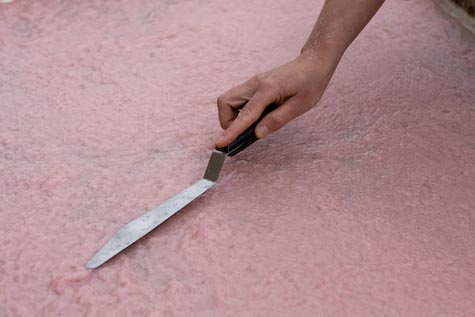
Often when we are working in class, pulp looks like food. Jean Funcke has some pinkish pulp that is so similar to cake icing that I wish someone had brought a birthday cake to class. Let’s take a moment to review why we even took this photo.Jean Funke smoothes over pulp Read more…

Categories: Art 466 Papermaking, art 466 Demos Tags:

Cotton pulp + elastic + underwire

April 23rd, 2008 admin No comments

Patricia LaPointe working on papermaking project.
Patricia LaPointe is constructing an object out of cotton pulp and an underwire structure. First placing a “de-constructed brassiere” on synthetic silkscreen material and outlining the shape with wet cotton pulp, she builds her shape.
Read more…

Etchings on abaca

April 17th, 2008 admin No comments

Etching on abaca paper by Waverly Liu

Waverly Liu printed an etching plate on thin sheets of abaca paper. The etching plate of the figure is larger than the plate. Thin abaca paper holds up to the etching printing process which requires dampening and drying. The prints are not flat but have a nice texutre and hold a plate tone as as background tint.

Categories: Art 466 Papermaking, art 466 Demos Tags:

Couch + Couch = Accordion fold book

April 15th, 2008 admin No comments

Jean Funcke accordion book

Jean Funcke made an accordion book by couching two sheets of handmade paper with pieces of ribbon between the two sheets. Once the sheets have been dried, they can be folded to create an accordion book. Note the texture of the paper that she used. Her paper is a mix of cotton fiber and cooked straw.

Andrea beats rags to a pulp

April 8th, 2008 admin No comments

Andrea showing pulp
Often, in class, the question is posed. “Is this pulp beaten enough?” Often my reply is, “It depends” In Andrea Brdek’s case, this pulp is almost ready for what she wants to do.
Read more…

Amanda Larson, work in progress

April 7th, 2008 admin No comments

Amanda Larson, a student working with Professor Mary Hark from the Design Studies Department is working on a large screen type installation using abaca pulp in the paper mill. Below are some process photos as she is building her pieces.

This is a detail of the piece. Read more…

Categories: Book Arts, art 466 Demos Tags:

In celebration of above freezing temperatures.

March 13th, 2008 admin No comments

Today we moved outside to form a large sheet of paper.

Read more…

Categories: Art 466 Papermaking, art 466 Demos Tags:

Question: How do you make a sheet of handmade paper?

March 12th, 2008 admin No comments

In no way is this a complete answer, but these ten photographs quickly show you how a sheet of paper is formed and couched. Andrea and Jean work as a team to form sheets of paper from cotton fibers.


Read more…

Making large sheets of paper

January 29th, 2008 admin No comments

Megan Page is showing the full frame for the sheet of paper. This frame is made out of 2×4 wood with silkscreen material.

Place the frame off the floor.

Megan is illustrating the slimy nature of formation agent.

This bucket hold several gallons of abaca pulp.

Abaca pulp is added to the 5 gallon pail of formation agent.

Water is added to fill the pail and mix the pulp.

Add water until the pail is full.

A spray hose is used to dampen the screen.

Megan secures the screen while Jim pours the pulp and formation agent onto the screen. Pour the solution as quickly as possible, without spilling it over the edge of the frame.

Quickly pick up the frame and rock the pulp slurry from side to side so that the pulp is distributed evenly over the frame.

The rocking may take a few minutes to allow the water to drain from the frame.

Once all of the water has drained, the wet frame can be set on supports.

In this case, we placed the wet sheet and frame on two large trash cans.

Take the shop vac and begin to suck water from the under side of the frame. The attachment is placed on the silk screen material.

The shop vac attachment must be moved all over the sheet to remove as much water as possible.

Continue moving the attachment all over.

The sheet should be left to dry for a day or two.

Once the sheet is dry, it must be carefully removed from the screen.

Carefully remove the entire sheet from the screen.

Students inspect a dry sheet